Automated External Defibrillators, or AEDs, are lifesaving devices that analyze a person's heart rhythm and deliver an electric shock during sudden cardiac arrest. Every second counts in a cardiac emergency, so choosing the best AED for your workplace, school, or home comes down to ease of use, durability, and the level of guidance it gives a rescuer.
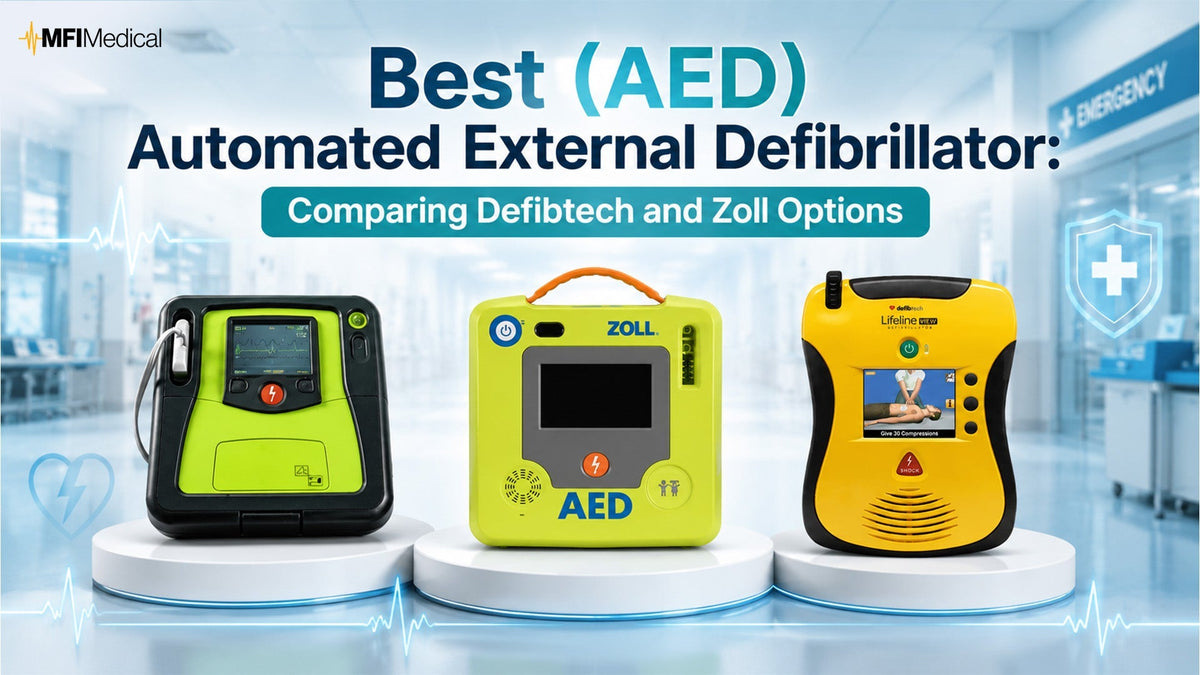
In this guide, we compare two of the most trusted AED brands in emergency medicine, Defibtech and Zoll, both available at MFI Medical. We cover the full Defibtech Lifeline Series along with Zoll's AED Plus, AED Pro, and AED 3 lineup, so you can find the best AED for your specific setting.
What Makes the Best AED for Your Situation?
Before comparing specific models, it helps to know what separates a dependable unit from the best AEDs on the market. Consider:
- Who will use it: trained medical staff or untrained bystanders
- Durability for your environment, from an office lobby to an outdoor or industrial site
- Real-time CPR feedback, plus voice or video guidance
- Battery standby life and warranty coverage
- FDA prescription requirements, since a prescription is required to purchase any AED
Defibtech Lifeline Series
Defibtech's Lifeline Series ranges from simple semi-automatic units to advanced models with video coaching and ECG monitoring.
Defibtech Lifeline AED

The Defibtech Lifeline AED is a semi-automatic unit built for total simplicity. It uses just two buttons, clear voice prompts, and lighted progress indicators to guide even untrained rescuers through a shock. Its sealed, rugged housing meets military standards for shock and vibration, and the battery lasts 5 to 7 years in standby.
Ideal for: offices, schools, and public spaces that want a dependable, no-frills AED anyone can operate under pressure.
Defibtech Lifeline AUTO AED

The Lifeline AUTO AED removes the shock decision entirely. It automatically analyzes heart rhythm and delivers a shock without requiring the rescuer to press a button, using a single on and off control. It shares the same rugged, weather-resistant housing and long battery life as the standard Lifeline AED.
Ideal for: high-traffic public settings where bystanders may hesitate to act, since the AUTO model removes that decision point.
Defibtech Lifeline VIEW AED

The Lifeline VIEW AED is the first AED to show full-motion color video instructions alongside voice prompts, walking rescuers through CPR and defibrillation step by step in real time. It includes a built-in metronome, IP55-rated water and dust resistance, and a data card for protocol upgrades and event storage.
Ideal for: workplaces and schools that want the extra reassurance of on-screen video coaching for untrained staff.
Defibtech Lifeline ECG AED

The Lifeline ECG AED adds a professional layer on top of the VIEW model, letting trained rescuers switch to a real-time ECG display instead of video coaching. It keeps the same metronome, protocol flexibility, and event documentation, with over 60 minutes of internal ECG storage.
Ideal for: clinics, fire departments, and EMS teams that want video guidance for bystanders and ECG detail for professionals in one device.
Zoll AED Line
Zoll's AED lineup is built around Real CPR Help, technology that gives rescuers live feedback on compression depth and rate.
Zoll AED Plus

The Zoll AED Plus uses Real CPR Help and See-Thru CPR to show rescuers the depth and rate of their chest compressions, while filtering out motion so the underlying ECG rhythm stays visible. It runs on off-the-shelf lithium batteries and CPR-D-padz electrodes rated for a 5-year shelf life, keeping long-term maintenance costs low.
Ideal for: workplaces and community organizations that want ongoing coaching through an entire CPR and shock cycle.
Zoll AED Pro

The Zoll AED Pro extends Real CPR Help and See-Thru CPR into a semi-automatic and manual unit built for both basic and advanced life support. Its 3-lead monitoring cable, Rectilinear Biphasic Waveform, and IP55-rated housing that passes a 1.5-meter drop test make it suited to demanding field use.
Ideal for: EMS crews, fire departments, and industrial sites that need professional-grade monitoring alongside AED functionality.
Zoll AED 3 and AED 3 BLS

The Zoll AED 3 pairs Real CPR Help with a color touchscreen display and WiFi connectivity that can report device status automatically. Its universal CPR Uni-padz work for both adult and pediatric rescues, and an 8-second pre-shock pause helps minimize time between compressions and the shock.
Ideal for: organizations that want a connected, low-maintenance AED with a 5-year battery and electrode life.
Quick Comparison

Which Is the Best AED for You?
If your priority is the simplest possible device for untrained staff, the Defibtech Lifeline AED or AUTO AED covers the basics well. Workplaces that want extra visual reassurance should look at the Lifeline VIEW or ECG models. If real-time CPR compression feedback matters most, the Zoll AED Plus is a strong everyday choice, while the AED Pro and AED 3 suit EMS teams, fire departments, and organizations that want professional monitoring or Wi-Fi-based device management. Whichever you choose, confirm your state's AED registration and prescription requirements before purchase.
Conclusion
Defibtech and Zoll both build dependable, well-supported AEDs, and the best AED for your organization depends on who will use it and how much guidance they need during a rescue. Browse the full range of AED Automated External Defibrillators at MFI Medical, and our team can help you match a model to your facility, budget, and required protocols.
Frequently Asked Questions
1. What is the best AED for a workplace or public space?
The best AED for most workplaces is one that untrained staff can operate confidently, such as the Defibtech Lifeline AED or Zoll AED Plus. Both use clear voice prompts and require minimal training, making them well suited to offices, schools, and community spaces.
2. Do you need a prescription to buy an AED?
Yes. The FDA classifies AEDs as prescription devices, so a purchase requires either an existing prescription or a prescription activation form completed by a physician after delivery.
3. How often does an AED battery need to be replaced?
Most AED batteries last 4 to 8 years in standby mode, depending on the model. The Zoll AED Plus and AED 3 both use 5-year batteries, while Defibtech's Lifeline AED offers a 5 or 7-year option.