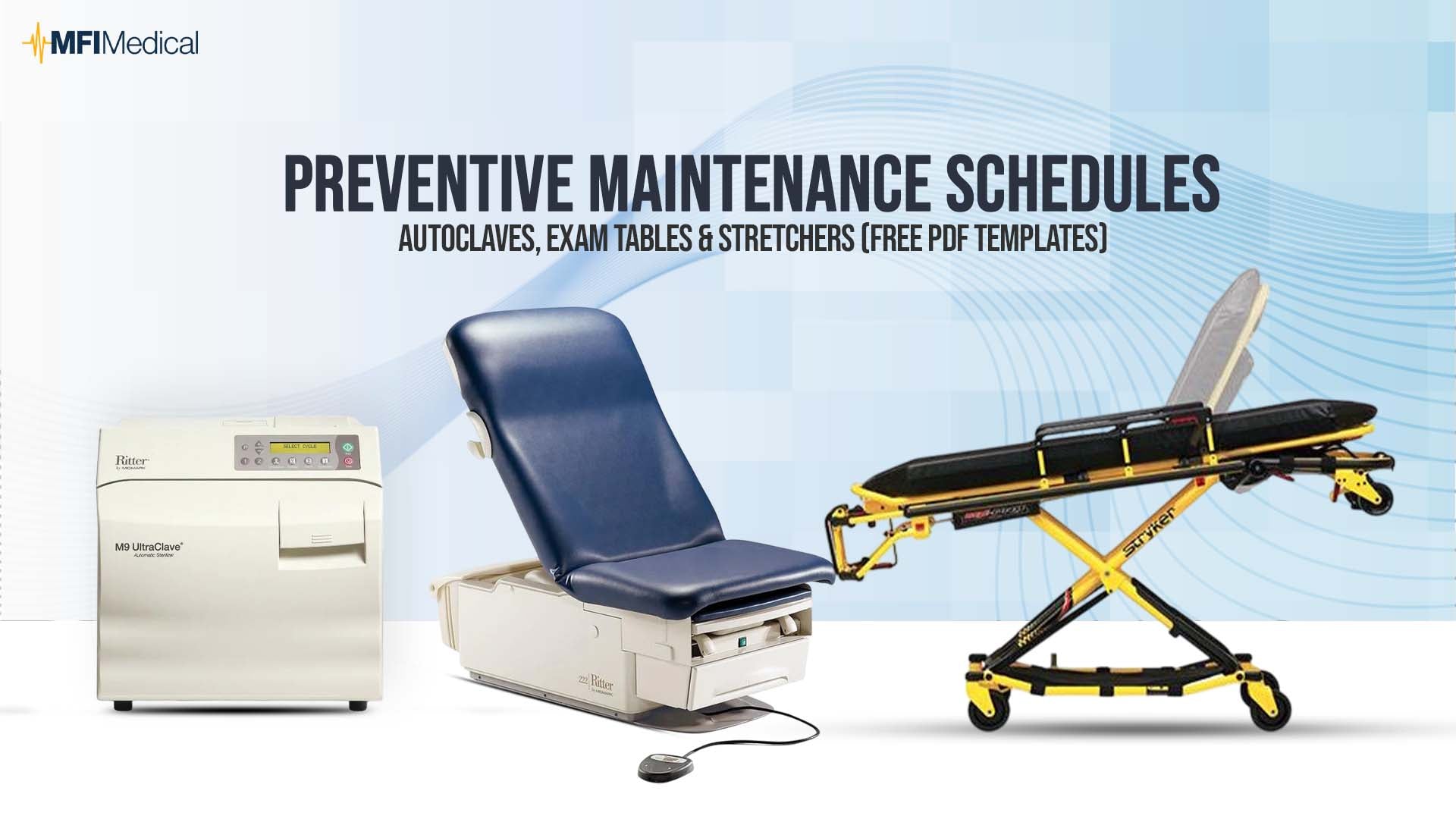
Keeping essential equipment in good condition helps prevent downtime, preserves lifespan, and supports compliance for clinics, ASCs, urgent cares, and hospitals. This guide breaks down simple, manufacturer-aligned preventive maintenance (PM) schedules for autoclaves, exam tables, and patient stretchers, along with free printable PDF templates you can use immediately.
Note: These are general guidelines. Always follow the manufacturer’s IFU/manual and your facility’s policies.
Autoclave/ Steam Sterilizer — Preventive Maintenance Schedule

A well-maintained autoclave ensures consistent sterilization and reduces expensive service calls. Use this schedule to support daily operation and long-term reliability.
Daily Tasks
-
Clean chamber racks and trays; wipe down exterior surfaces.
-
Inspect and clean the door gasket.
-
Check water or sterilant levels (use distilled water if required).
-
Record cycle parameters and outcomes in the log.
-
Confirm printer/tape/USB cycle recording is functioning.
Weekly Tasks
-
Drain and refill the reservoir (per IFU).
-
Deep-clean trays and chamber; descale as recommended.
-
Clean/inspect the air intake filter (if applicable).
-
Run vacuum/air-removal test on prevac units.
Monthly Tasks
-
Inspect the door latch and safety interlock.
-
Visually check the safety/relief valve; schedule testing as required.
-
Check gauges against expected readings; schedule calibration if due.
-
Inspect tubing, hoses, and the power cord.
Quarterly Tasks
-
Descale heating elements and internal chamber (as needed).
-
Replace chamber filters as specified in the IFU.
-
Validate sterilization using biological and chemical indicators.
Semiannual Tasks
-
Professional inspection of seals, sensors, valves, and firmware.
Annual Tasks
-
Full PM by a qualified technician: replace door gasket, calibrate temperature/pressure sensors, and test the safety valve.
Autoclave PM Template (PDF)
Use this printable checklist with your team or include it in your CMMS.
Download Autoclave PM Template (PDF)
Exam Table/ Procedure Chair — Preventive Maintenance Schedule

Exam tables and procedure chairs support every patient interaction, so regular PM keeps them safe, smooth, and dependable.
Daily Tasks
-
Clean and disinfect surfaces.
-
Inspect upholstery for tears or wear.
-
Test power and mechanical adjustments (height, tilt, backrest).
-
Check power cords, plugs, and footswitches.
Weekly Tasks
-
Tighten fasteners, joints, and hinges per IFU.
-
Inspect casters or leveling feet (if mobile).
-
Check accessory rails, stirrups, or armboard mounts.
Monthly Tasks
-
Check for hydraulic or pneumatic leaks and unusual noises.
-
Inspect wiring and strain reliefs.
-
Lubricate approved points (per manufacturer).
Quarterly Tasks
-
Functional load test under typical patient weight.
-
Verify brakes/interlocks or limit switches.
-
Inspect seams, foam, and upholstery condition.
Annual Tasks
-
Professional PM: replace worn gas springs, belts, upholstery, and other major components.
Exam Table PM Template (PDF)
Print and post near the room or upload to your CMMS for easy tracking.
Download Exam Table PM Template (PDF)
Patient Stretcher/ Gurney — Preventive Maintenance Schedule

Stretchers move more than almost any other equipment in a facility. Consistent PM keeps them safe, stable, and ready for transport.
Daily Tasks
-
Clean and disinfect frame, rails, and mattress.
-
Check brakes, steering casters, and directional lock.
-
Inspect side-rail locks and height/tilt/Trendelenburg adjustments.
-
Inspect straps and restraint points.
Weekly Tasks
-
Inspect casters for debris or flat spots; tighten mounting hardware.
-
Check IV poles, O₂ holders, and accessory mounts.
-
Inspect mattress cover and seams for wear.
Monthly Tasks
-
Check hydraulics for leaks; verify fluid levels (if applicable).
-
Inspect frame welds, fasteners, and linkages.
-
For powered stretchers: inspect cords, batteries, chargers, and alarms.
Quarterly Tasks
-
Perform a functional load test; verify braking distance and stability.
-
Inspect grounding/anti-static components (if applicable).
Annual Tasks
-
Professional PM: replace worn casters or brake components, inspect gas springs/hydraulics, and verify performance.
Stretcher PM Template (PDF)
Use this checklist for daily, weekly, monthly, and annual PM routines.
Download Stretcher PM Template (PDF)
How to Use These PM Templates
-
Print & Post: Keep one copy in Biomed/Facilities and one near each device.
-
Assign Responsibilities:
-
Daily: Clinical staff
-
Weekly/Monthly: Facilities/Biomed
-
Annual: Vendor/qualified technician
-
Use the Maintenance Log: Document dates, results, staff initials, and attach vendor service reports.
-
Set Calendar or CMMS Reminders: Prevent missed PM intervals.
-
Stock Replacement Parts: Keep common consumables (filters, gaskets, lubricants) on hand.
Keep Costs Down While Staying Compliant
Price Match Guarantee — We match or beat most competitor pricing.
Free Invoice Audit — Send 30–60 days of invoices; we’ll identify savings & equivalents.
Subscribe & Save (2%) — Automate consumables and save on every order.
Shop Essentials:
Since 1980, MFI Medical has helped clinics, ASCs, and hospitals maintain safe, reliable equipment at the lowest possible prices.
Frequently Asked Questions
1. How often should an autoclave be calibrated or validated?
Follow the manufacturer’s IFU and your internal policy. Many facilities validate cycles with biological and chemical indicators on a routine basis and calibrate sensors during annual PM.
2. Can clinical staff perform all preventive maintenance tasks?
Daily cleaning and basic checks can be done by clinical staff. Monthly, quarterly, and annual tasks—especially electrical or hydraulic work—should be handled by Biomed or qualified technicians.
3. Do autoclaves require distilled water?
If the IFU specifies distilled or treated water, you must use it. Hard water increases scaling, sensor issues, and service costs.
4. How should preventive maintenance be documented?
Use a PM checklist, sign/initial each task, and attach vendor service reports and calibration certificates. Keep records accessible for surveys or inspections.
5. What replacement parts should we keep on hand?
Most facilities maintain door gaskets, filters, printer paper, and approved lubricants. Subscribe & Save can help automate reordering.